

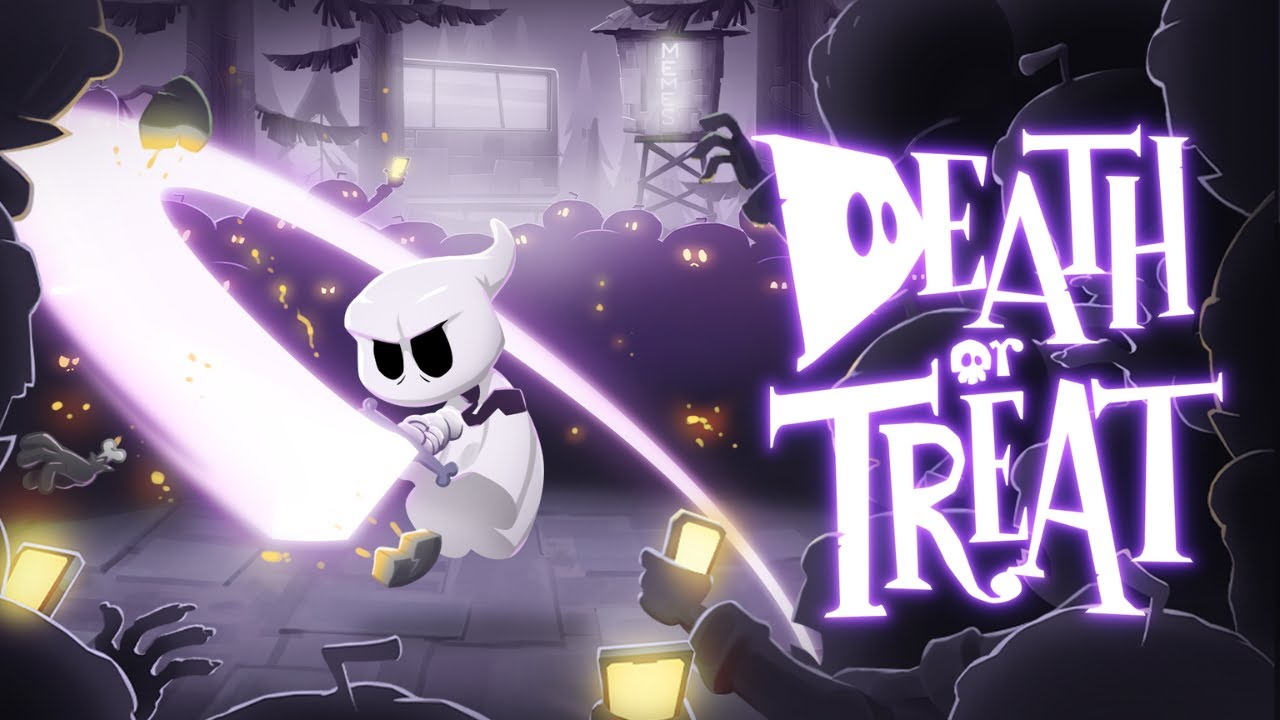
Saona Studio’s Death or Treat is a hand-drawn hack & slash rogue-lite with procedural levels set in HallowTown. You take the role of Scary and it’s your job to combat the evil Clark Fackenberg, whose social media companies are keeping its citizens high on Storyum through their Deviltube, Darkchat, Riptok, and FaceBoo! Apps. Each of these levels is packed with references, deep Internet cuts techies would know, and a boss fight with a rip of a major player in social media — Jeff Beezelboss and Fackenberg being examples of what I mean. This is something I’ll be coming back to later.
Rogue-lites are an interesting genre and one that’s really difficult to nail down. The reason is they require a player to play the same levels over and over again until they’ve grinded enough merit that they are capable of finally beating whatever is in front of them. This often presents a problem as most players do not like playing the same levels over and over again. To combat this, some games have introduced procedural levels, but we’ll also come back to this in a minute.
Death or Treat looks incredible on paper and the opening of the game sets the standard for the type of art you can expect from the title. It is a really fun aesthetic and draws you in with its charm. As you set out on your quest, you have three weapons you can choose from in addition to Scary’s basic and dynamic attacks like an uppercut. The dynamic attacks don’t cost you any magic, but the weapon does and you will have to refill it after every use. Early on, this can be pretty difficult, so you may want to save the weapon for those segments when you really need it.
The controls for Scary are smooth and work tremendously well. Whether it’s running, jumping, or even double-jumping to reach other areas, Scary reacts favorably to your inputs and is an easy character to use for exploration. It’s just a shame that the game does not motivate the player to return to older areas for said exploration. There are several reasons for this, but the primary reason is that you’ll be sick as hell with the procedural levels from that area.
Remember the procedural levels I promised to discuss later? Well, it’s later. This is totally fine if you’ve created an extensive amount of content from which the game can draw, but that does not seem to be the case with Death or Treat. Part of the reason it took me so long to get to a point where I felt like I could review this game was because playing the exact same scenarios over and over really wears on anyone. I’m not sure if it was just my game, but I saw another review mention seeing the same levels.
While the art & techie mentions are really awesome at first, they both suffer from the same problems in that they wear out their welcomes extremely quickly, even if they are for different reasons entirely. The art suffers from the aforementioned, but the techie stuff eventually becomes so deep that I, honestly, missed a ton of it. It is done with solid intentions and it is absolutely in keeping with its premise, but sometimes things can be considered too niche for many people. I would argue this is especially the case for folks who were expecting a simple hack & slash with gorgeous hand-drawn art. Nobody was expecting to be hit with technology deep cuts.
One of the things I hate about being a games reviewer is when you really want to like something and you just find you can’t. Before someone screams “bias,” what are we even doing if we are not hoping to enjoy games when we play them? This game checked so many boxes and I really thought I would like it. While dealing with a flooded house has definitely taken up most of my time, playing Death or Treat to reach a point where I could review it was shortly behind it. The biggest reason was the progression rate.
Like any rogue-lite, it’s a balance between giving folks a challenge and allowing them the power fantasy they’re looking for when playing these games. Death or Treat took over an hour to unlock my first power-up. I will happily admit to some of it being a skill issue, but the other part was the difficulty early on and the amount of stuff required to open the shops needed to enhance Scary’s runs. Even after you open the shop, you have to spend an equally long time gathering up the ingredients for your first actual power-up because you used everything you had to reopen the store.
When you add significant progression problems to the issue of playing those same early levels over and over and over and over again, it really does frustrate your early experience. If you push through and get those unlocks, the boss battles and later levels do provide you with a ton of enjoyment, especially your final romp through FaceBoo! The bosses for every one of these levels also include unique art and challenges, adding to the enjoyment. It really does have some quality moments, they’re just not as frequent as I would prefer.
At the end of the day, you have to try games for yourself. When I look at the overall number of things I like about this game, there are more of them than things I do not like. It’s just that the things I don’t like are more prominent and critical to the infrastructure of the game. I really wanted to like this game and I think I am still going to try another run with a bit more experience. I also think it’s worth a grab if you can get it for super cheap or if you really, really love rogue-lites. Other than that, I would wait until it’s put on one of the services and you can download it for free.
BSO Rating: 6.5