
OKLAHOMA CITY – The win came, but not gently.
It arrived bruised and breathless, dragged across forty-eight minutes and an overtime that felt heavier than it should have.
The Thunder beat the Jazz 129-125 on Wednesday night, but the scoreboard tells only the ending, not the struggle. This was a game Oklahoma City once held with ease, then lost in thier own hands, then reclaimed through resolve rather than rhythm.
For a while, in the first half, the night flowed. The Thunder moved with freedom, built a 20 point lead in the second quarter, and looked like a team washing away the residue of their recent stretch. The ball popped. The pace hummed. The game leaned their way. And then, quietly at first, then all at once, it slipped.
Possessions grew careless. Focus softened. Utah crept closer, not with brilliance, but with persistence. By halftime, the lead was nearly gone. By the third quarter, it was gone entirely. What had once felt like control became survival.
This is where ugly basketball lives, in turnovers that echo louder than makes, in missed box-outs, in defensive rotations half a step late. Oklahoma City only committed 11 turnovers but each one a small fracture in the night, each one offering Utah belief.
Championship teams don’t live here [their recent stretch] often. Young teams do.
And yet, the Thunder did not collapse.
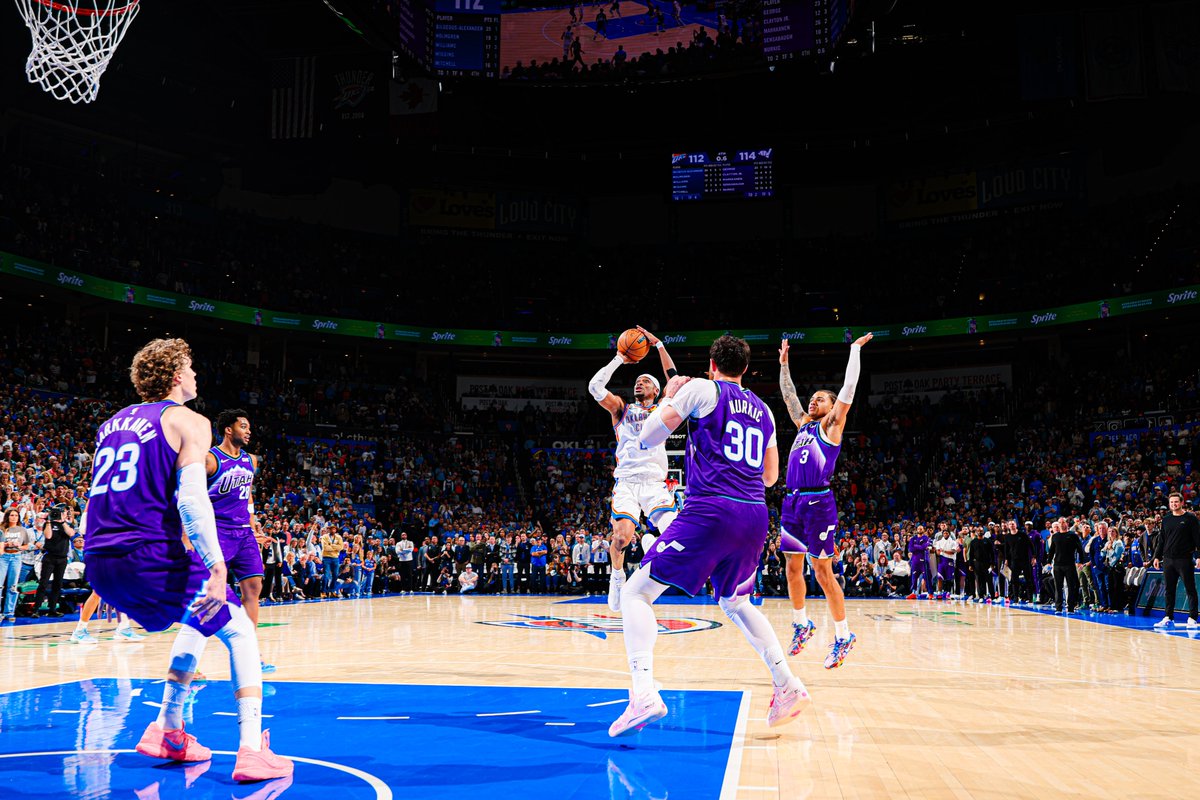
They bent. They staggered. They trailed by eight with five minutes left, the building tense, the game tilting away. Utah landed the punch it thought would finish it with Lauri Markkanen twisting through traffic, releasing a reverse put-back as the shot clock expired, three seconds left, silence hovering.
Then Shai Gilgeous-Alexander stepped into the stillness.
No rush. No panic. Just balance and breath. A pull-up from near the free-throw line, the horn, the net. Tie game. Overtime. Exhale.
Gilgeous-Alexander carried the night the way stars do when games become unrecognizable. 46 points. 17 trips to the free-throw line. 9 points in overtime. A steady hand when everything else shook. His streak grew to 109 straight games of 20 or more points, but this wasn’t about numbers, it was about presence. When the game frayed, he held it together.
Around him, Chet Holmgren fought in the margins with 23 points, 12 rebounds, 3 blocks, standing tall as Utah attacked the paint again and again. Jalen Williams filled spaces, scoring 17 and moving the game forward even when it stalled. Ajay Mitchell, inefficient but fearless, added 16, proof that effort still counts when polish fades.
The Thunder won in overtime, but the victory felt complicated. The kind that lingers. The kind that asks questions instead of answering them.
Championship teams don’t often let games unravel like this over and over as the Thunder have during their recent stretch. They don’t build 20 point leads and then forget how they were built. They don’t rely on late heroics as a nightly ritual. Oklahoma City knows that. They can feel it. That discomfort is the point.
Because growth is rarely clean.
This team started the season flying, and now the turbulence has arrived. Bad habits are forming featuring careless stretches, uneven urgency, moments of assumed control. But the season is long, and lessons tend to stick harder when they hurt a little.
Wednesday night wasn’t a masterpiece. It was a mirror.
The Thunder saw who they are, and who they still need to become. They survived themselves. They survived the moment. And they walked off the floor with a win that may matter more for what it revealed than how it looked.
Sometimes progress isn’t pretty. Sometimes it’s loud, imperfect, and exhausting.
Sometimes it takes overtime.