
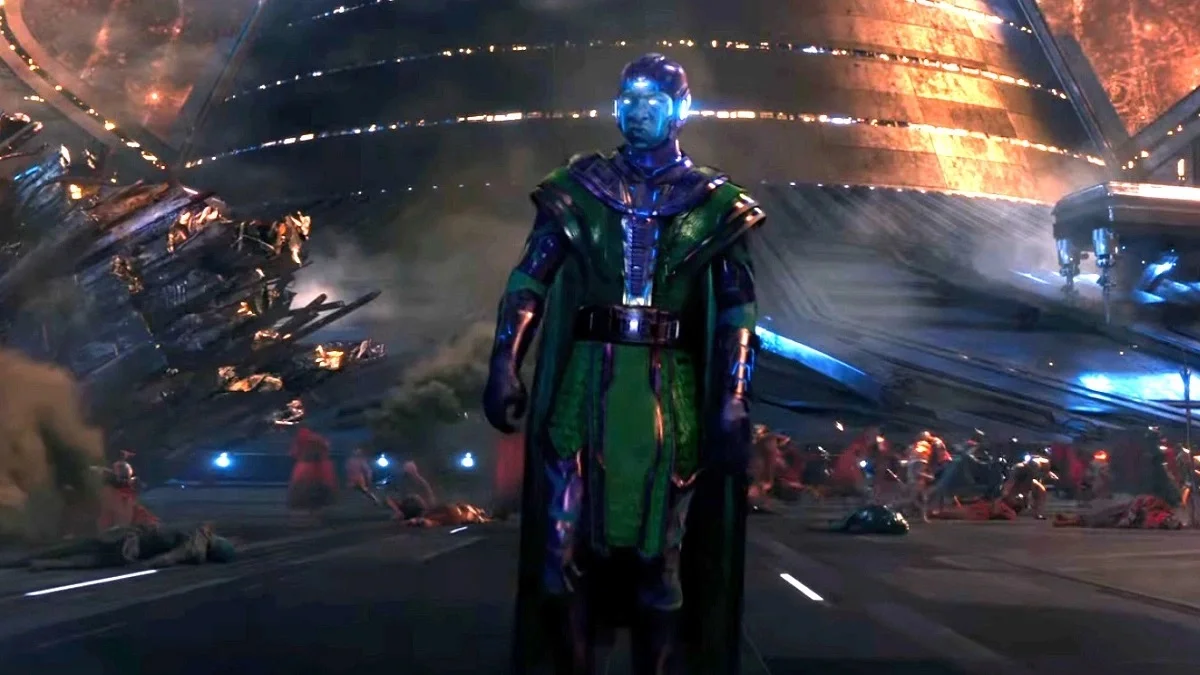
The Marvel Cinematic Universe continues to roll along this month with the release of the third film in the Ant-Man franchise, Ant-Man and the Wasp: Quantumania directed by Peyton Reed. While the first couple of Ant-Man films were fairly grounded and linear adventures, this one is anything but. Largely taking place through CGI, the vast majority of this film was much different than what people were used to seeing from Scott Lang and the reason was the introduction of Kang the Conqueror as the primary antagonist for not just Ant-Man, but also the Avengers.
If you’re interested in a full review of the film, our Rob Littal wrote up an excellent and fair review of the film, one that I largely happen to agree with, as well. But the purpose of this column is to explore more of what the film did not, Kang, specifically the Council of Kangs. You’d be forgiven if you didn’t know what the Council of Kangs was, as the film really didn’t explain them much except naming them one time — they called it the “Dynasty of Kangs” — and giving viewers the general idea that they destroyed timelines, which is true but not exactly contextual. Think of me as a cleanup hitter in your lineup, I’m stepping up to the plate to knock home the information that didn’t get there through Loki season one, Dr. Strange in the Multiverse of Madness, and Ant-Man and the Wasp: Quantumania.
SPOILERS — AVOID IF YOU HAVEN’T SEEN THE FILM OR WANT TO AVOID SPOILERS
The first post-credit scene is the one that really gives us our first glimpse at the Council of Kangs. We see three different versions of Kang. One dressed like a pharoah, one dressed like he is in Tron: Legacy cosplay, and another dressed like a druid seemingly giving orders to the rest. These are three of Kang’s most well-known variants. The pharaoh is named Rama-Tut. The Tron-Kang is actually called Scarlet Centurion, and the druid-looking dude in charge goes by Immortus. We also see a fourth version in the second post-credit scene who goes by Victor Timely, but we’ll circle back to that later.
Rama-Tut is the original Kang who came from Earth-6311 and traveled back to ancient Egypt because he apparently enjoys a lack of modern plumbing and decides to become a pharaoh. This works out for him until it doesn’t and then he tries to become the Scarlet Centurion, which also fails. It’s at this point that stuff gets really weird and Kang meets his future self, Immortus, who manages to convince Kang that all this crap he’s done has actually hurt himself in the future. This leads to Kang defeating Kang and yeah. It’s all weird, I know. If you’re struggling, just basically think of Kang as a really overpowered man from the future who ends up trying to save as many timelines as he destroys. Fun fact about pharaoh Kang, he was in charge of ancient Egypt when En Sabbah Nur AKA Apocalypse from the X-Men franchise was created.
He’s definitely not a one-note villain and if we’re being honest, he’s not even a full villain. There have been plenty of positive experiences with Kang and plenty of pretty apocalyptic experiences with him, as well. It primarily depends on which version the Avengers are facing and whether or not Kang’s life will be impacted in any major way. If Kang is going to be adversely affected, you can bet he’s going to help the Avengers or whomever else he needs to if it means helping himself or a future version of himself. The Council of Kangs is basically the checks and balances system that Kang has employed to keep things from becoming wildly unstable and out of even his hands.
This is why Kang asks Scott if he’s killed him when he mentions he’s an Avenger. Depending on the timeline, Kang has killed many different Avengers. Being that he comes from the 30th century, the technology upon which he relies is so far beyond the Avengers’ level of understanding that they’re simply incapable of beating him heads-up. As he’s also capable of traveling through time, he knows what they’re going to try before they try it, almost giving him a certain level of omniscience. This should give you a good idea of what these Kangs plan to do when they arrive in Loki’s timeline, as was shown at the end of the post-credit scene.
The second post-credit scene ties directly into Loki and He Who Remains — the Kang variant from the Loki show — as Loki and Mobius M. Mobius appear in the early 19th-century at a science show where a mysterious figure, soon revealed to be a Kang variant, appears on stage talking about controlling time to a captivated audience that just happens to include our intrepid time-travelers from the Disney+ show. The last thing we hear is Loki assuring Mobius that, despite his geeky look, Kang is as dangerous as anyone they’ve ever come across.
Victor Timely is the version of Kang that was beaten by the Avengers and sent back in time to the 19th-century. It’s here in rural Wisconsin that Kang founded the town of Timely and eventually became Mayor. Kang uses his technology and knowledge to create robot versions of himself that are actually capable of aging, thus giving the impression that different robots were Victor Timely Jr. and Victor Timely III down the line. It’s actually this version of Kang that gave Phineas T. Horton, who would later create the original Human Torch. If you hadn’t figured it out by now, this dude is responsible for quite a bit of Marvel’s in-universe history.
As for what this means, the Council of Kangs are going to come to this timeline and absolutely wreck shop. I wouldn’t be surprised if he kills a couple of Avengers, they will have to establish him as more dangerous than Thanos on some level, but he’s also going to crush everything they’ve built and repurpose it for his own means. There will be an extended period of time in which the Avengers can do nothing to stop this from happening and will likely need the help of Mantis (more on that in another column) and Kang to stop the Council of Kangs. There’s a lot more to unpack, so keep it locked here on BSO for more info on the Council of Kangs and what’s next for the Avengers.
Kane Webb is an entertainment journalist for @BSO and @TheMarvelReport. He also writes about the USC Trojans for @AthlonSports and has been featured on @FanSided, @Scout, @Rivals, the Bakersfield Californian, Wisconsin State Journal, and much more. You can follow him on Twitter: @FightOnTwist
Flip the page for a video of post-credit scene.