
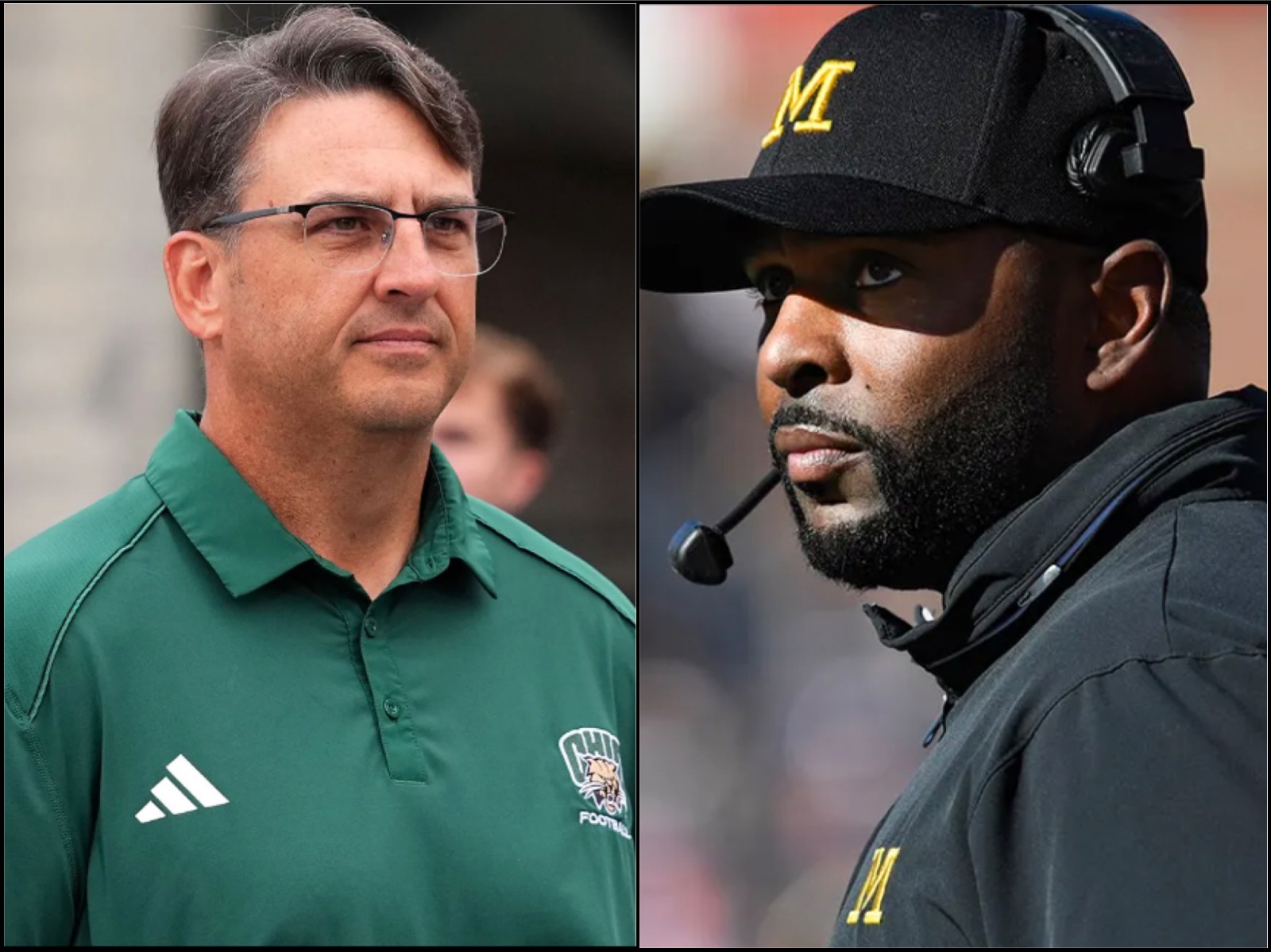
In a December defined by chaos for Midwestern football, the “for cause” firings of Michigan’s Sherrone Moore and Ohio University’s Brian Smith have drawn inevitable comparisons. While both involve allegations of off-field misconduct and the potential loss of millions in buyout money, the legal and policy frameworks surrounding the two cases are starkly different.
Industry analysts and legal experts suggest that while Moore’s career at Michigan has largely imploded due to criminal charges and clear-cut policy violations, Brian Smith may have a much stronger path to recovering his contract money.
The Similarities: Power and Policy
At first glance, both programs followed a similar playbook:
-
“For Cause” Termination: Both universities cited contract clauses related to conduct that reflects unfavorably on the institution to avoid paying massive buyouts—Moore was owed roughly $13.9 million, while Smith’s contract value was significant for the MAC level.
-
Romantic Allegations: Both coaches were accused of engaging in inappropriate relationships that violated the spirit or letter of university standards.
-
Sudden Timing: Both firings occurred in early December, disrupting bowl game preparations and leaving programs under interim leadership.
The Differences: Policy vs. Criminality
The similarities end once you look at the specifics of university policy and the coaches’ behavior following the allegations.
| Feature | Sherrone Moore (Michigan) | Brian Smith (Ohio) |
| Relationship Target | A direct staff subordinate. | An undergraduate student (not a staffer). |
| Policy Violation | Explicit ban on supervisor/subordinate dating. | No specific policy barring staff/student dating. |
| Legal Complications | Charged with felony home invasion and stalking. | No criminal charges; purely administrative. |
| Disclosure | Allegedly concealed a multi-year affair. | Claims he did not hide the relationship. |
Why Brian Smith Has the Stronger Case
While Moore’s legal team faces an uphill battle against both university policy and criminal felony charges, Brian Smith’s attorney, Rex Elliott, has already signaled a “vigorous” legal fight. Here is why Smith’s case for his buyout is viewed as more robust:
1. The “Subordinate” Distinction
Michigan’s policy is airtight: supervisors cannot date subordinates. Moore was the staffer’s boss, creating a clear “for cause” trigger. In contrast, the woman Smith dated was an undergraduate student not employed by the athletic department. Smith’s defense argues that because he had no “supervisory or evaluative” role over her, he violated no specific university rule.
2. Absence of a “Dating Ban”
Ohio University does not have a blanket policy prohibiting employees from dating students, provided there is no direct power imbalance. Smith’s team argues that “disrepute” is a subjective standard that cannot be used to void a contract when no specific policy was broken.
3. The “Bourbon” Defense
The university also cited alcohol-related conduct against Smith. However, Smith’s lawyers have countered with claims that university officials—including the President’s husband—actively provided the alcohol in question. This “selective enforcement” argument is a powerful tool in contract litigation that Moore simply doesn’t have.
4. The Post-Firing Conduct
Moore’s case is severely damaged by his arrest hours after his firing. The allegations of “barging” into the staffer’s home and threatening self-harm provide Michigan with a massive amount of leverage to argue that his conduct was “detrimental to the university.” Smith, conversely, has remained out of legal trouble, keeping the focus strictly on the interpretation of his contract.
As Michigan moves forward with an expanded investigation into its athletic department, Ohio University is bracing for a potential wrongful termination lawsuit. While Moore may be fighting to stay out of prison, Smith is fighting for his paycheck—and according to the rulebooks, he has a much better chance of winning.