

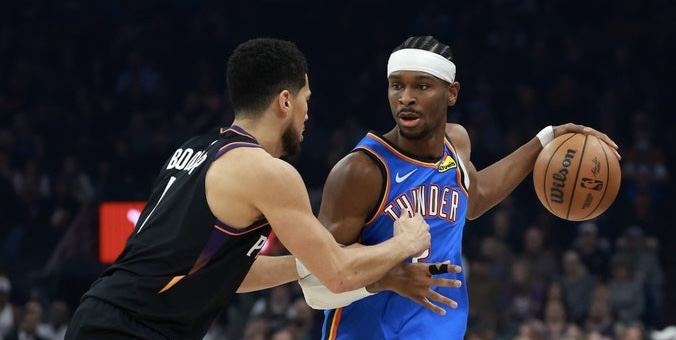
OKLAHOMA CITY — Numbers usually tell the story in straight lines. Think of how they’re displayed on graphs.
With Shai Gilgeous-Alexander, they curve, they echo, they linger a little longer than expected. They don’t just explain what happened, they hint at something unfolding in real time.
And this season, those numbers led him to the league’s ultimate recognition of late game dominance, the 2025–26 NBA Clutch Player of the Year award. A fitting honor for a player who has turned pressure into routine.
One hundred seventy five.
That’s the total. The league’s highest mark in clutch scoring during the 2025–26 season. Not empty accumulation, not volume for volume’s sake, each point arriving in the final five minutes, with the margin thin enough to feel every possession. These weren’t just buckets. They were answers to pressure. To expectation. To the moment itself.
6.48.
His clutch points per game. A number that doesn’t just lead the league, it brushes against history. Night after night, when the game slowed and the noise sharpened, Gilgeous-Alexander didn’t search for the moment. He met it. There’s a rhythm to that kind of consistency, a quiet repetition that turns late game chaos into something almost predictable.
Over 50 percent.
Efficiency in a place where efficiency is supposed to disappear. Defenses tighten. Help comes quicker. Space evaporates.
And yet, he remained untouched by the usual erosion. His shot diet, midrange pull-ups, controlled drives, free throws earned through patience, became a blueprint for late game scoring. No rush. No panic. Just precision.
Twenty four and ten.
That’s the clutch record for the Oklahoma City Thunder. Because numbers only matter if they move something bigger than the box score. And this did.
These weren’t isolated performances, they stacked into wins, into control of games that could have gone either way. When Oklahoma City needed direction late, the ball found Shai, and the outcome usually followed.
Plus 33.
A quieter number, easy to overlook, but it hums beneath everything else. The Thunder didn’t just hold steady in clutch minutes, they outpaced opponents decisively. That margin speaks to more than scoring. It reflects decision making, timing, and the ability to read a defense already stretched thin.
But even with all of it laid out, the numbers still fall short of the full picture.
They don’t show the hesitation that sends a defender leaning the wrong way.
They don’t capture the way he glides into a spot, rises, and releases without disruption.
They don’t account for the stillness he brings to moments designed to feel frantic.
There’s a tempo to his game that resists urgency. Where others speed up, he slows down. Where others force, he waits. And in that space, between movement and pause, he creates something defenses can’t quite solve.
That’s what separates these numbers from the rest.
Clutch scoring often comes with difficulty, with contested shots and last second improvisation. Gilgeous-Alexander found another path. His efficiency suggests something cleaner, something repeatable. He didn’t survive the moment, he shaped it before it could turn unpredictable.
And this season wasn’t an outlier. It was a continuation.
Over the past few years, his rise has been steady, almost quiet compared to the noise that usually surrounds superstardom. But the numbers have been building, season after season, stacking into something impossible to ignore. This year, they crystallized.
175 points.
6.48 per game.
Over 50 percent shooting.
A 24–10 record when the margin is smallest.
A +33 swing when everything matters most.
Individually, they stand out. Together, they form something cohesive, something that feels less like a hot stretch and more like mastery.
Clutch Player of the Year is often about moments, about the shots that replay in highlights and live in memory. But this season, it was about accumulation. About showing up in those moments again and again, until it stopped feeling surprising.
Until it started feeling inevitable.
Because that’s what the numbers ultimately reveal.
Not just greatness. Not just consistency. But control.
And in the final minutes of a close game, control is everything.