

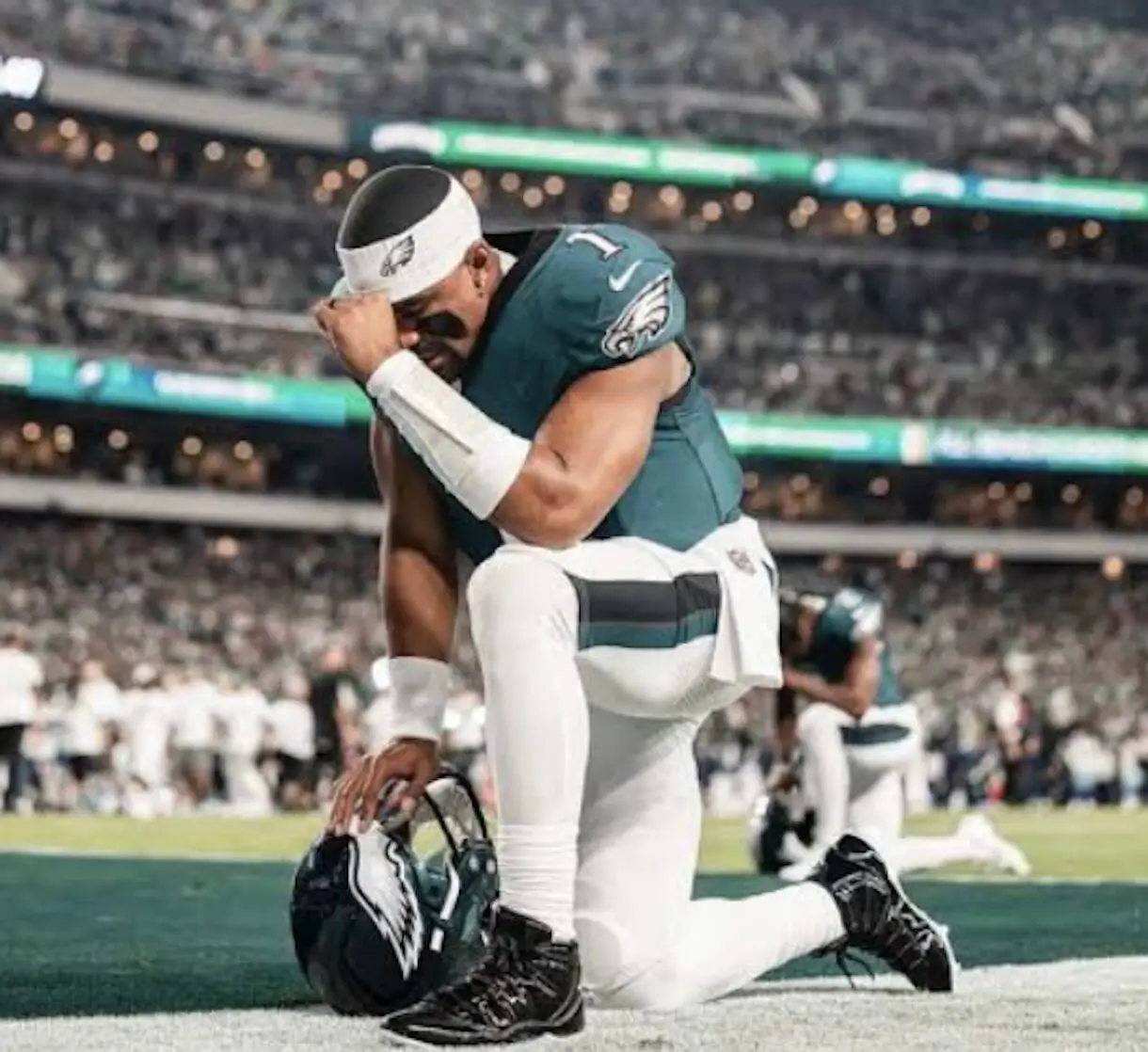
Philadelphia Eagles quarterback Jalen Hurts is expected to miss the rest of the 2026 season after doctors diagnosed deep vein thrombosis and bilateral pulmonary emboli, raising questions about whether the team could face legal liability for clearing him to play earlier with a known blood clot or whether Hurts effectively waived any claim by choosing to take the field.
Hurts, 28, was initially diagnosed by specialists in London with a left calf superficial vein thrombosis after an ultrasound following the team’s arrival for its Week 5 game against the Jacksonville Jaguars. Team medical staff and the London doctors reviewed the results and determined that activity and mobility were important and that Hurts could safely play. He started that game, completing 21 of 40 passes for 220 yards and a touchdown in a 19-17 loss, after reportedly remaining awake for roughly 36 hours as a precaution.
A follow-up ultrasound later revealed movement in the clot. Further testing confirmed deep vein thrombosis and bilateral pulmonary emboli — blood clots in both lungs. In a joint statement Monday with agent Nicole Lynn, the Eagles said Hurts is clinically stable with no significant functional limitations. His treatment involves anticoagulation (blood thinners), during which he cannot participate in any contact activities, including football. The team said his prognosis is very good, a full recovery is expected, and no long-term effects are anticipated. Reports indicate the recovery timeline of roughly three months will likely end his season.
The initial superficial clot was linked to trauma: Hurts sought treatment after being cleated in the calf during the Eagles’ Week 4 loss to the Los Angeles Rams on Oct. 4. Superficial vein thrombosis is generally less dangerous than deep vein thrombosis, but experts note that roughly 10 percent of such clots can progress to deeper veins or pulmonary embolism. Medical literature and prior athlete cases (including NBA players such as Chris Bosh, Victor Wembanyama and Damian Lillard) show blood clots can sideline or end careers, particularly when they travel to the lungs.
On the question of legal liability, sports injury claims against teams and team physicians often turn on the distinction between inherent risks of the sport and alleged negligence in medical clearance or treatment. Players assume the risks that are inherent to football — tackles, collisions, and the physical nature of the game — under the long-standing assumption-of-risk doctrine. That defense does not automatically bar claims alleging that medical staff increased risk through a negligent clearance decision or failed to meet the standard of care.
— Nicole Lynn (@AgentNicoleLynn) October 19, 2026
Team physicians owe a duty of care to the player as a patient. Courts have held that this professional duty is not erased by the competitive environment or team interests. A notable precedent involving the Eagles themselves is the case of former safety Chris Maragos, who was awarded tens of millions of dollars by a Philadelphia jury against an orthopedic surgeon and Rothman Orthopaedics for alleged negligent post-surgical rehabilitation that contributed to a career-ending knee injury. The jury found the medical providers failed to properly manage his recovery despite imaging that showed ongoing issues.
Under the NFL collective bargaining agreement, players have rights to second medical opinions and a degree of autonomy over treatment decisions. However, teams and their medical staff retain significant control over clearance to practice and play. There is no public indication that Hurts signed a specific injury waiver related to the blood clot, unlike contract addendums sometimes used for pre-existing conditions (as seen in past cases involving players such as Jimmy Garoppolo). General participation in the sport does not typically constitute a waiver of claims for medical negligence that falls outside the ordinary risks of play.
Any potential claim would face substantial hurdles. Establishing that the initial clearance was negligent — rather than a reasonable medical judgment that activity was beneficial for a superficial clot — would require expert testimony on the standard of care. Causation would also need to be shown: that allowing Hurts to play in London caused or worsened the progression to deep vein thrombosis and pulmonary emboli, rather than the condition progressing independently or due to the original trauma and travel. Claims against the team or league could also encounter labor-law preemption issues under the CBA, which often channels injury-related disputes into grievance procedures rather than civil courts.
Eagles QB Jalen Hurts is expected to be sidelined for multiple months after new imaging over the weekend found several blood clots in his lungs.
Hurts is now on blood thinners and should have no long-term effects. But it’s unlikely he plays again this season. pic.twitter.com/iLhCBu0Isa
— Tom Pelissero (@TomPelissero) October 19, 2026
Workers’ compensation systems in most states further limit players’ ability to sue their employers for workplace injuries, though exceptions can exist for intentional misconduct or certain medical malpractice claims against individual providers. The Eagles have stated that Hurts’ health and safety are the highest priority and that he will remain active around the team while conditioning during recovery. No lawsuit has been filed or publicly discussed.
In short, while the decision to clear Hurts to play with a diagnosed superficial clot creates a factual basis for scrutiny of the medical judgment, prevailing on a liability claim would require proving negligence that exceeded the ordinary risks Hurts assumed by playing professional football — a high bar that has succeeded in some medical malpractice cases involving NFL players but is far from automatic.


