
OKLAHOMA CITY – In the postseason, some stretches are defined by tactical changes. Others come down to who can hit the toughest shots. But every so often, the outcome is shaped by pure pride. A team digging in and refusing to be humiliated.
Wednesday night in Game 2, the response came fast and that’s mostly because it had to.
For almost 48 hours the noise around the Oklahoma City Thunder centered around panic, adjustments and whether they had an answer for Victor Wembanyama after dropping Game 1 to the San Antonio Spurs. The easy answer everyone settled on was simple: put Chet Holmgren on Wembanyama full time and scrap the double big lineup that sputtered in the opener.
But the Thunder rarely follow the “obvious” script.
When everyone expected them to zag, Oklahoma City zigged. They doubled down on the very thing people questioned most.
And this time, they made it work.
Behind a much sharper game-plan on both ends of the floor, a desperate edge and another MVP performance from Shai Gilgeous-Alexander, the Thunder evened the Western Conference Finals with a 122-113 win Wednesday night inside Paycom Center. The series now heads to San Antonio tied 1-1, but emotionally this felt far bigger than just avoiding a two game hole.
This was pride basketball.
This was a team playing like its season was hanging in the balance.
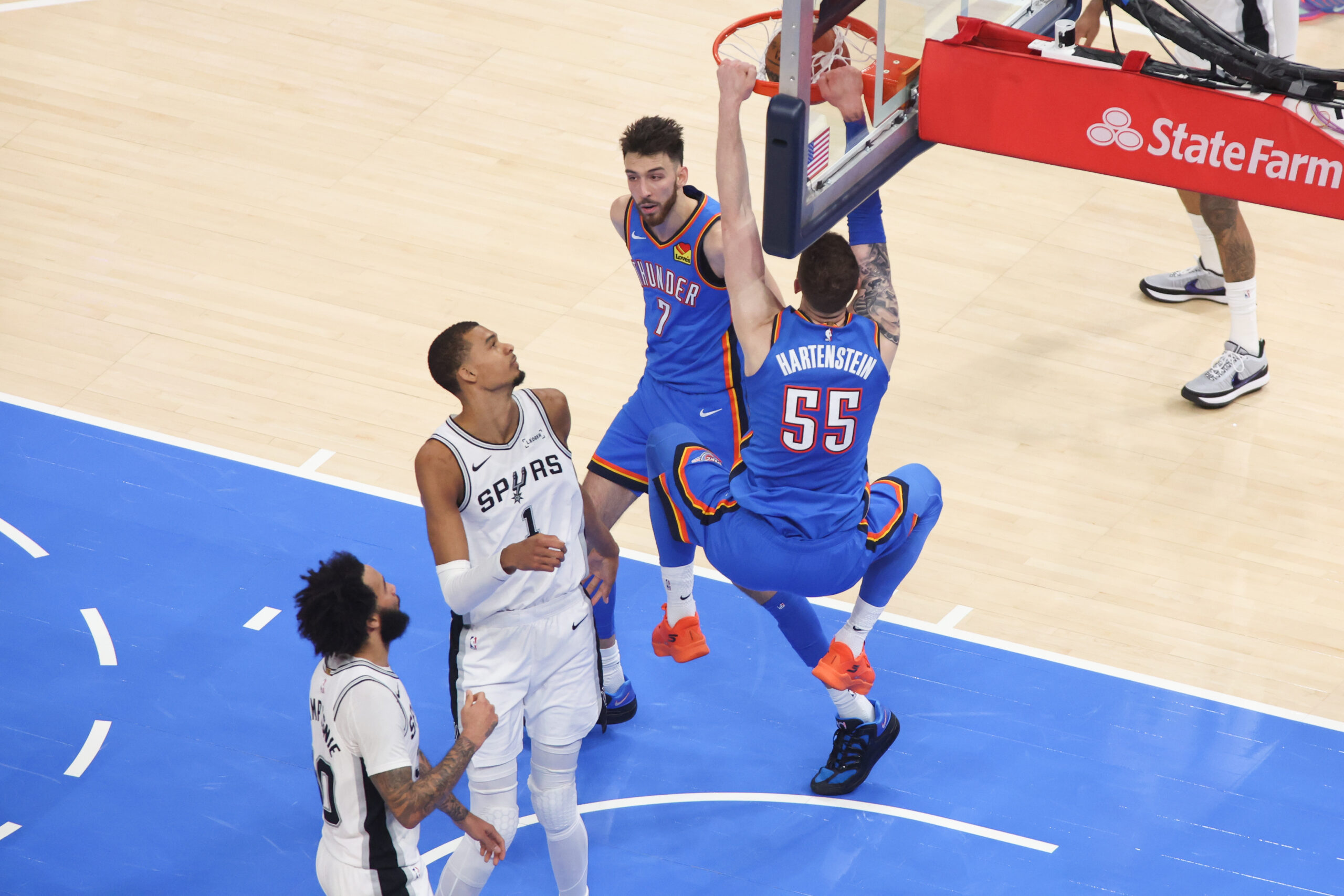
The biggest adjustment came immediately. Instead of fully abandoning the double big lineups, Oklahoma City leaned harder into them. Isaiah Hartenstein drew the primary matchup on Wembanyama and changed the tone of the game before the first quarter even settled in.
In Game 1, Wembanyama was allowed too many comfortable catches and too much freedom operating in space. Wednesday was different. Hartenstein crowded him. Bumped him. Forced him off spots. The Thunder denied entries harder and made every touch feel exhausting.
If Wembanyama wanted the ball, he had to fight for it first.
And while Wembanyama still produced a monster stat line with 21 points, 17 rebounds, 6 assists and 4 blocks, the game itself felt much harder for him. Oklahoma City dictated more of the terms physically instead of reacting to San Antonio’s pace and length.
That was the point.
The Thunder refused to let the Spurs control the style of the game again.
The other major wrinkle came offensively. Oklahoma City made Wembanyama work constantly on defense. They pulled him into actions, forced switches, screened him repeatedly and attacked him with movement instead of allowing him to sit comfortably near the rim as a free safety.
The Thunder didn’t necessarily reinvent themselves. The energy looked similar to Game 1. The effort was already there two nights earlier.
The execution was not.
Wednesday, the execution finally matched the desperation.
“I thought we all played better,” Mark Daigneault said afterward.
“I had a quiet confidence about that. I didn’t know if we’d win or lose the game, but I was pretty sure after watching Game 1 and knowing our team that we were going to come out and play better tonight.”
The opening quarter almost felt playful at times. Fast paced. Emotional. Both teams trading punches while trying to establish control. But somewhere in the second quarter the Thunder stopped treating the game like a heavyweight exchange and started treating it like survival.
That’s when they landed the punch.
Oklahoma City exploded behind their bench unit and defensive pressure, eventually taking a double digit lead into halftime. Unlike Game 1, when the Spurs always seemed to keep the Thunder at arm’s length, this time OKC became the team creating separation.
And every single time San Antonio threatened, the Thunder answered.
That was the difference.
The Spurs cut the lead to 99-97 midway through the fourth quarter after a Harrison Barnes three pointer. In Game 1, that moment probably flips the game entirely. Wednesday, Oklahoma City responded with an 11-0 burst that effectively broke San Antonio’s momentum for good.
A banked in three from Jared McCain ignited the crowd. Defensive stops piled up. Transition opportunities followed. The Thunder never allowed the Spurs to fully climb the mountain.
That composure mattered.
Because San Antonio kept swinging.
Even shorthanded without De’Aaron Fox and later losing Dylan Harper to injury, the Spurs kept threatening to turn the game chaotic. But Oklahoma City controlled the emotional rhythm almost the entire night.
The Thunder bench was enormous, outscoring San Antonio’s reserves 57-25. Alex Caruso scored 17 points off the bench while McCain and Cason Wallace added 12 apiece. Hartenstein finished with 10 points and 13 rebounds in one of his most important games of the postseason.
And then there was Gilgeous-Alexander. The MVP looked like the MVP again.
After criticism following Game 1, Gilgeous-Alexander responded with 30 points, nine assists and complete control whenever Oklahoma City needed calm. Every Spurs push seemed to run directly into him. Every important possession eventually found the ball in his hands.
“The guys brought it tonight,” Gilgeous-Alexander said.
“Knowing what it would have meant if we lost this one, we brought the energy from the jump.”
That urgency showed up everywhere.
The Thunder forced 21 Spurs turnovers and turned them into 27 points. They competed on the glass. They defended with purpose. They played with force instead of hesitation.
Most importantly, they played with pride.
There are moments in the playoffs where adjustments matter. There are moments where shotmaking decides everything. And then there are moments where a team simply refuses to let itself get embarrassed.
This was one of those nights for Oklahoma City.
The Thunder understood exactly what going down 0-2 would have meant heading into San Antonio. They understood the questions waiting for them if they folded again. So they responded the only way contenders can.
By fighting harder.
By making the game uglier.
By making Wembanyama uncomfortable.
By refusing to back down.
When pride is on the line, basketball changes. The intensity sharpens. Every possession feels heavier. Every loose ball matters more.
And on Wednesday night, the Thunder looked like a team whose pride demanded a response.