

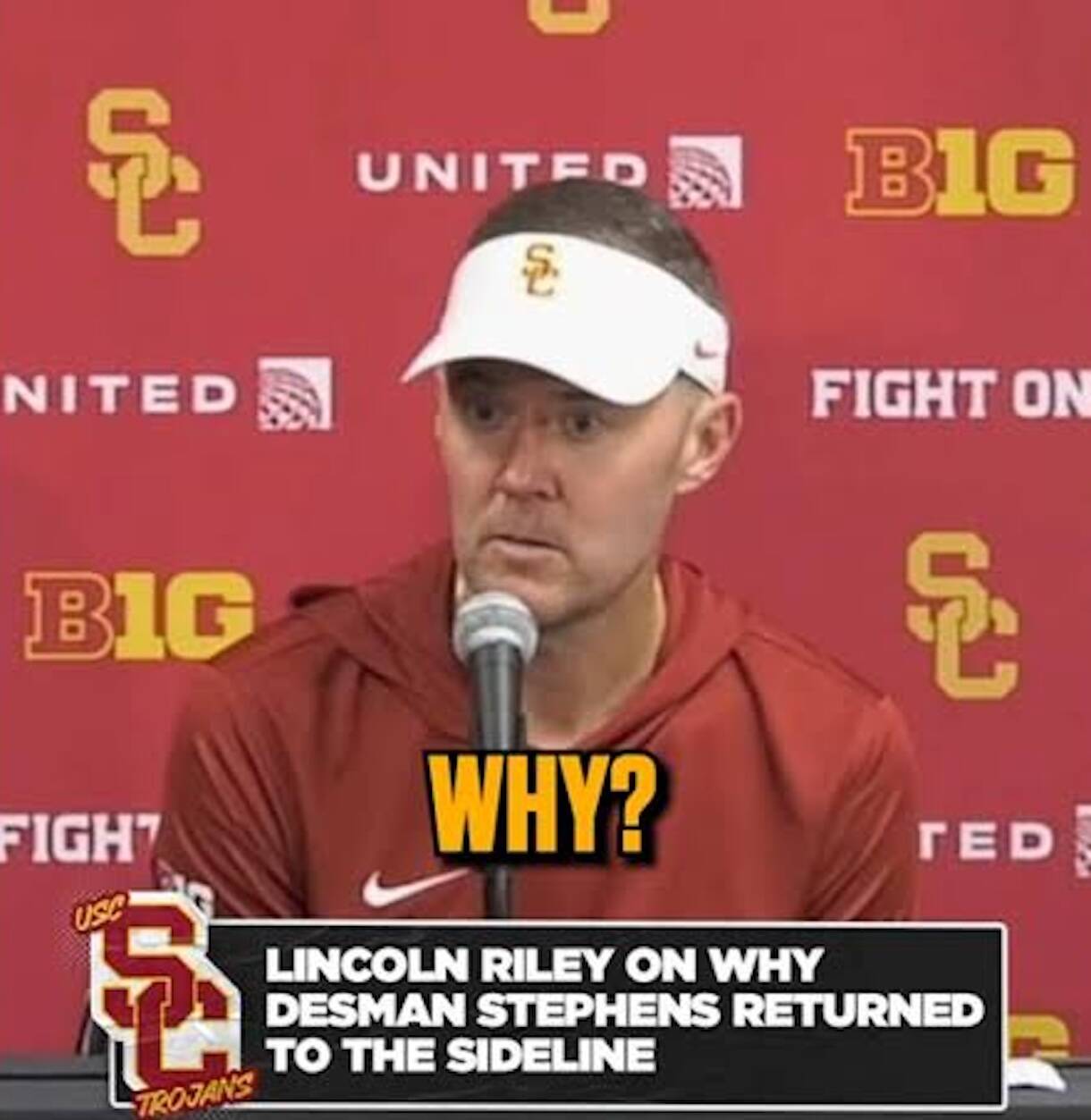
Lincoln Riley is facing a familiar storm after No. 12 USC’s 41-27 home loss to No. 20 Oregon on Saturday night, but the sharpest criticism is not coming from the Ducks sideline. It is coming from Trojans fans who say the loss, the targeting hit that sent Oregon quarterback Dante Moore to the hospital, and Riley’s muted response together exposed a program that still cannot win its biggest games and will not police its own players.
Oregon won its Big Ten opener at the Los Angeles Memorial Coliseum after Moore left the game in the second quarter. USC linebacker Desman Stephens II was ejected for targeting when he delivered a forearm and shoulder to Moore’s head as the quarterback slid after a scramble near the USC 13-yard line. Moore lay motionless, was placed on a backboard, carted off, and taken by ambulance to Los Angeles General Medical Center. Oregon players and coaches called the hit dirty and, in some cases, intentional. Coach Dan Lanning labeled it “a disgusting play.”
Stephens was seen celebrating after the collision — gesturing, smiling, and later high-fiving teammates on the sideline even after he had been ejected. Riley said he did not see the celebration. Asked why Stephens was allowed back onto the sideline for the second half instead of remaining in the locker room, Riley answered, “Because he’s on our team.” He opened his postgame remarks by saying he hoped Moore was OK and that “these are all people at the end of the day.” Lanning later noted that Riley asked about Moore during the handshake.
Lincoln Riley responds to questions about Desman Stephens returning to the sideline following the hit on Dante Moore. pic.twitter.com/631RSZ5LCO
— FOX College Football (@CFBONFOX) September 27, 2026
Moore was later reported to have suffered a concussion and was expected to enter protocol, with no timetable announced. Backup Dylan Raiola replaced him and threw for 289 yards and two touchdowns as Oregon scored 28 second-half points and finished with 504 total yards. USC quarterback Jayden Maiava threw for 326 yards, but the Trojans’ defense could not contain either Oregon quarterback. The Ducks outscored USC 28-17 after halftime.
The game was framed as a referendum on Riley’s tenure. USC entered 4-0 and ranked No. 12. Oregon arrived 2-1 after an early loss to Oklahoma State. Riley is now 0-3 against Lanning. Under Riley, USC is 5-15 against ranked opponents, according to one postgame assessment, and has repeatedly fallen short in games that were supposed to announce a return to national contention.
Riley called it “a hell of a game” that came down to a couple of plays. That framing did not satisfy the people who have watched the same pattern for several seasons: talent on offense, a defense that surrenders yards in bunches, and a failure to close when the opponent is wounded.
Last night was not the first time a USC player coached by Lincoln Riley celebrated after injuring a player on the field
This was from the Rutgers game in 2024
I think it’s fair to say they have a culture problem with this kind of stuff pic.twitter.com/0x821T1FLD
— Jared Smith (@jaredsmithbets) September 27, 2026
The targeting call itself was straightforward under current rules. Moore was sliding. Stephens lowered his shoulder into the quarterback’s head. Officials ejected him after review. What lingered was everything that followed.
Video showed Stephens celebrating while Moore was still on the ground. Oregon players rushed the scene. A scuffle broke out. After the ejection, Stephens remained on the USC sideline in jersey and sweats, waving a towel and exchanging congratulations. NBC analysts called the sideline scene “a bad look for USC.” Oregon players said they believed the hit was on purpose. Lanning said if there was celebration, it was “really disappointing,” while adding that he did not see it himself and that Riley’s concern for Moore was appreciated.
Riley’s answers were brief. He wished Moore a speedy recovery. He said he did not see the gloating. He said Stephens stayed on the sideline because he is on the team. College football rules allow an ejected player to remain on the sideline; they do not require a coach to keep him there after a player has been carted off. Critics argued Riley had a chance to send a message about values and declined.
The sequence became the image of the night: Moore on a stretcher, Stephens still visible and upbeat on the USC sideline.
Oregon players and coaches were angry in the moment and pointed in their comments. Neutral observers and national columnists piled on. The most sustained fury, however, has come from the USC fan base and USC-aligned writers.
Trojans Wire published an opinion piece arguing that Stephens should be dismissed from the program and that his lack of remorse reflected a broader absence of accountability under Riley. Fans on social media called for Riley’s job, citing both the loss to a team missing its starting quarterback for most of the game and the decision to leave Stephens on the sideline. One widely circulated post said Riley “had a chance to stand up and be a leader, instead he gave a schoolyard answer.” Others tied the episode to a longer record of undisciplined play and losses in games that were supposed to matter.
That reaction is not new in form, only in intensity. Riley was hired to restore USC as a playoff regular. The program has resources, recruiting reach, and a historic brand. What it has not produced under him is a consistent ability to beat the teams it must beat, or a public standard that matches the old “Fight On” self-image when a player’s conduct looks ugly on national television. Fans who already doubted whether Riley was a “big-game coach” now add that he did not look like a program-builder when the cameras were on the stretcher.
The contrast with Lanning’s postgame comments was hard to miss. Lanning condemned the play, praised his team’s focus, said his players respect the game, and still credited Riley for asking about Moore. Riley’s own fan base heard a coach protecting the locker room first and the program’s reputation second.


