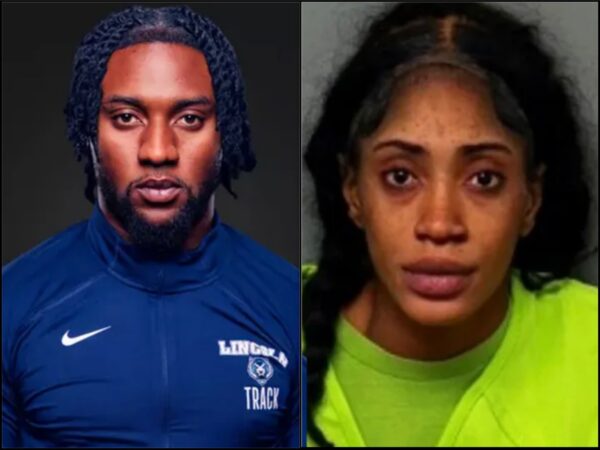


In the early hours of February 23, 2026, a confrontation at an off-campus residence in Jefferson City, Missouri, turned deadly, claiming the life of 23-year-old Jamaican track star Kevaughn Goldson and leading to murder charges against his 27-year-old girlfriend, Denita Atiyah Jackson. Both students and athletes at Lincoln University, their relationship—marked by reported domestic violence—ended in a stabbing that has sparked discussions on self-defense, infidelity, and the complexities of intimate partner disputes. This comprehensive examination draws from court documents, athletic records, news reports, and legal precedents to outline everything known about Jackson, dissect the incident, analyze potential legal strategies, and offer an informed perspective on the case’s trajectory, informed by similar outcomes in Illinois.
@robertlittalbso LU Track Athlete Denita Jackson stabbed her boyfriend Kevaughn Goldson to death after she caught him with her roommate. Innocent or Guilty? #cheater #courttv #track
♬ Jazz Hip Hop in the early 90’s(219692) – TOKYO Lonesome Blue
Who Is Denita Atiyah Jackson? A Profile of the Accused Athlete
Denita Atiyah Jackson, born around 1999, hails from Berbice, Guyana, a region known for its coastal landscapes and agricultural roots. She attended Rosignol Secondary School before relocating to the United States to pursue higher education and athletics at Lincoln University, a historically Black institution in Jefferson City, Missouri. As a senior sprinter on the women’s track and field team, Jackson stands at 5 feet 7 inches and has competed in events like the 100m, clocking a personal best of 12.41 seconds (with a 2.0 wind) at a 2024 meet hosted by her university. Her athletic profile also includes participation in cross-country, showcasing her versatility as a runner.
Jackson’s move to Missouri appears tied to her academic and athletic ambitions, though she is described in court documents as a Jefferson City resident. At the time of the incident, she was employed, leaving work early on the night in question due to illness. Public records reveal no prior criminal convictions, but her relationship with Goldson was reportedly turbulent, with a documented history of domestic violence incidents. Sources indicate the couple had been together for years, with police aware of previous disputes, though details such as the nature or frequency of these events remain undisclosed in initial reports.
Beyond athletics, Jackson’s personal life is sparsely documented. Social media and university profiles paint her as a dedicated student-athlete, but the stabbing has thrust her into the spotlight, with mugshots circulating widely. She is currently held without bond in Cole County Jail, awaiting further court proceedings. Lincoln University issued a statement expressing condolences and offering counseling, emphasizing community support without commenting on Jackson’s status as a student.
Breakdown of the Murder: Timeline, Evidence, and Charges
The incident unfolded at Jackson’s home in the 800 block of Fairmount Boulevard, Jefferson City, shortly after 1 a.m. on February 23, 2026. According to probable cause statements, Jackson left work early feeling unwell and returned to find her bedroom empty—where she claimed Goldson had been when she departed. Suspecting infidelity with one of her roommates, she used a hairclip to unlock the roommate’s door and discovered Goldson in bed with the roommate, both clothed.
A physical altercation ensued: Jackson allegedly jumped on the bed, grabbed Goldson by his shirt, and confronted him about a missing cologne bottle. The fight escalated, with Goldson reportedly ending up on top of her and choking her. Jackson then reached for a knife under the bed and stabbed him once in the back and once in the chest. She immediately called 911, reporting the stabbing.
Police arrived to find Goldson with severe wounds; he was rushed to Capital Region Medical Center and airlifted to University Hospital in Columbia, where he died during surgery. Jackson was arrested around 8:29 a.m. that morning. Cole County Prosecutor Locke Thompson charged her with second-degree murder under Missouri Revised Statutes §565.021, which applies when someone knowingly causes another’s death or commits a felony resulting in death. An additional charge of armed criminal action stems from using a deadly weapon in a felony.
Key evidence includes Jackson’s statements to investigators, the knife’s location, wound patterns (suggesting close-range combat), and the couple’s domestic violence history, which prosecutors may use to establish motive or pattern. No witnesses beyond the unnamed roommate have been publicly identified, and forensic details like autopsy reports are pending.
Kevaughn Goldson and the History of Domestic Violence
To fully contextualize the tragedy, it’s essential to highlight Goldson, a 23-year-old senior from Kingston, Jamaica. A 6-foot, 160-pound sprinter, he attended Kingston College, competing in track and football before joining Lincoln’s men’s team. His personal bests include strong showings in the 100m, 200m, and 400m, with international rankings in relays. Goldson’s death has devastated his Jamaican community and alma mater, with tributes emphasizing his talent and character, but there is a darker side others are painting.
Multiple reputable news outlets, citing the probable cause statement filed in Cole County, have reported on the domestic violence history between Jackson and Goldson. For instance, KOMU News detailed a “yearslong ‘volatile relationship'” with prior domestic violence reports. Similarly, ABC17 News noted that the suspect and victim “had a history of domestic violence and were in a romantic relationship”. These reports emphasize that the relationship spanned years and involved police awareness of previous disputes, though no specific incidents are publicly detailed beyond the general history.
Likely Defense Strategy: Self-Defense and Battered Partner Context
Under Missouri law, self-defense justifies deadly force if one reasonably believes it’s necessary to prevent imminent death, serious injury, or a forcible felony, with no duty to retreat (stand-your-ground). Jackson’s team will likely argue she feared for her life during the alleged choking, portraying the stabbing as a last resort. Evidence of prior domestic violence could invoke a battered partner defense, highlighting cumulative fear rather than isolated intent. If self-defense fails, they might seek a reduction to voluntary manslaughter, citing “sudden passion” from discovering infidelity. Expert testimony on trauma responses in abusive relationships could humanize her actions.
Prosecution’s Counterattack: Intent, Initiation, and Pattern
Prosecutors will challenge self-defense by emphasizing Jackson’s proactive role—picking the lock and initiating contact—arguing she was the aggressor. They’ll portray the history of violence as mutual or her-driven, using it to show premeditation or recklessness. Physical evidence, like multiple stabs, may undermine claims of minimal force. If framed as felony murder (e.g., tied to assault), self-defense becomes unavailable under Missouri law. Witness statements from the roommate could contradict her account, bolstering a narrative of intentional killing.
Comparative Analysis: Similar Cases in Missouri and Potential Outcome
While the case is in Missouri, examining Missouri precedents provides insight into outcomes for domestic stabbings with self-defense claims. Missouri law allows self-defense if force is reasonably necessary, but imperfect beliefs can reduce first-degree murder to second-degree.
| Case Name | Key Facts | Self-Defense Claim | Outcome | Relevance to Jackson Case |
|---|---|---|---|---|
| State v. White (2002) | Defendant shot partner during argument; claimed fear after physical aggression. | Rejected as excessive; sudden passion argued. | Guilty of second-degree murder; reversed on instructional error. | Highlights conviction risk if force deemed disproportionate, similar to multiple stabs here. |
| Carla Welch (2024) | Fatal stabbing of ex-partner in dispute. | Not asserted; domestic context. | Guilty of second-degree murder (plea); 18 years. | Shows potential for lesser murder conviction in domestic stabbings without strong justification. |
| State v. Brandolese (2020) | Assault with knife in domestic fight. | Accepted but imperfect; initial aggressor issue. | Guilty of second-degree domestic assault. | Illustrates how initiation negates pure self-defense, relevant to Jackson’s confrontation. |
| State v. Livingston (2023) | Shooting in altercation. | Rejected by jury. | Guilty of second-degree murder. | Demonstrates conviction when self-defense fails in violent disputes. |
| State v. Williams (1990) | Force used in abusive relationship. | BSS admitted to support claim. | Admissibility affirmed; conviction on record. | Shows BSS can aid reductions in DV self-defense, but not always acquittal. |
These cases reveal a pattern: Full self-defense succeeds rarely in domestics without clear imminent deadly threat; more often, charges reduce acknowledging complexity. In Jackson’s favor, her 911 call and choking claim add credibility, but initiation may tip scales.
Opinion: Expect a conviction on reduced charges like voluntary manslaughter (10-30 years in MO), balancing evidence of passion and violence history, mirroring Missouri trends toward empathy in debated domestics without absolute certainty.
Flip the pages for photos of Denita Atiyah Jackson.